Saturday, 10 December 2011

Southern Bolivia and Northern Argentina


Hey Everyone,

We have been overdue for a posting for a while so there is a lot to tell! Last time we wrote we had just returned from the jungle and were headed to Sucre. Sucre was by far the nicest city in Bolivia. It is the judicial capital and home to the country's supreme court, as well as several nice parks, colonial buildings and architecture. We spent 3 days in Sucre (which was one more than planned due to road blocks created by political protesters - the norm in Bolivia - that prevented us from leaving when we wanted to) exploring and enjoying the more pleasant side of Bolivia. A highlight was our walk up to the city's mirador (lookout) where there was a great view and a cafe that had a quinoa beer! So Shaina was able to have her first beer in 5 months!

Marsh at the lookout in Sucre


Shaina with a bottle of Lipena - a beer made from Quinoa which was surprisingly good!

We left Sucre and took the bus to Potosi, which is a city famous for its mining history. The mines in the mountain overlooking the city were said to have funded the Spanish empire with their vast amount of silver. The mines are still active today and are home to some of the worst working conditions on earth. They are hot, there is little to no technology used, the air is full of asbestos and silica and the miners are very likely to die of silicosis after just 15 years of working! However, there are over 15,000 people in Potosi that head to the mines every day to make a living. There are also several tour operators in the city that bring tourists into the mines to catch a glimpse of the every day lives of the locals. We took a tour and were in shock/awe at the miners willingness to work in such harsh conditions every day for such long hours! The miners were very friendly and seemed to appreciate our presence. This was likely due to the fact we brought them presents in the form of juice and coca leaves....

Shaina in her mining attire

Literally crawling through the mines down to the third level!

Miners with a trolley full of rocks

Marsh doing some work in the mine (and sweating profusely from the heat)

After the mine tour we also toured a museum that used to be the home to the national mint. The silver did not used to travel far before it was converted into currency....

The next day, we headed further south to the town of Tupiza, from where we wanted to take a tour of the famous Salar de Uyuni (the worlds largest salt flat). We had a great group - two girls (an American and an Italian) and a guy from Switzerland. The tour is normally 4 days but we extended ours to 5 days as the group wanted to try to summit the Licancabur Volcano (more on that later).

On day 1 we headed out of Tupiza with our group of 5, our driver/guide, and our cook. We quickly climbed from 2300 masl to 4200 masl and had some spectacular scenery along the way!

Overlooking a valley with some drastically eroded rocks

The town where we spent the first night

Day 2 we headed into the National Park and made several stops to see the native wildlife, some beautiful lagoons, and some spectacular natural hot springs. We stopped for the night at the base of the Licancabur Volcano, which we would attempt to summit in the early hours the next morning.

Wild ostrich roam the grasslands

Flamingos taking flight in one of the many lagoons where they spend the summer months

Soaking in natural hot springs with a view that's hard to beat!

Us at the Laguna Verde and Licancabur Volcano in the background

We woke up on day 3 at 1:30am in order to get an early start up the volcano (if you start later it gets very windy and therefore more dangerous). We got out of the jeep at 4600 masl and hoped to make the summit at a mindblowing 5960 masl in around 6 hours! The summit would be by far the highest we have climbed but we were hopeful that spending most of our time in Bolivia at high elevations would have us well prepared. We started the ascent in the dark at around 3am with amazing views of the stars. We climbed in the cold night for what seemed like forever but when the sun came up the views were fantastic!

The day's first light with a star-studded sky. (photo taken by Elia in our group)

The view from 5300 masl just after the sun had come up!

Shaina and the other girls climbing with the laguna verde and laguna blanca in the background

We continued climbing and could feel the thin air the higher we got. After 5,500 masl it was tough to breathe and you could feel your head pounding. However, we pressed on and amazingly, our entire group was able to make the summit! (normally about 50% of the people who attempt the climb cannot make the summit) From the top we had a 360 degree view and could see all the way into Chile!

Us at the top of the volcano! By far the highest we have ever climbed at 5960 masl!

After reaching the top exhausted, we still had to go all the way back down.....the descent was easier but were were completely drained when we got back to the jeep after a round trip of over 9 hours! It was the hardest thing we have ever done and we are very proud to have reached the summit! We piled back into the jeep and made our way towards the salt flats with a couple stops at some geysers and more flamingo-filled lakes.

Thousands of Flamingos in Laguna Colorada

Day 4 was mostly in the Jeep making our way North towards the salt flats. We saw some very cool rock formations that resembled everything from camels, lions, mushrooms, Fallopian tubes, and the world cup of soccer trophy. We spent the night in a hostel made from salt! The bricks, furniture, and floor were all made of salt!

The group "riding" the camel rock on day 4

Day 5 had us up early again and we arrived at the Salar de Uyuni in time for sunrise! Driving through the salt flats was like being in another world with white as far as the eye can see. We made stops at an "island" with some giant cacti (over 8m tall and thousands of years old), a lookout halfway up another volcano, and had some fun taking pics before the long jeep ride back to Tupiza.

Marsh watching the sunrise over the Salar (photo taken by Vittoria in our group)

Isla Incahuasi in the middle of the Salar

Shaina blowing a "shrunken" Marsh off her hand.....

The group in the Salar

The view of the valley just outside Tupiza

The tour was an amazing experience, unlike anything we had seen before, and a highlight of the trip! The next day, we left Bolivia behind and eagerly crossed the border into Argentina. We stopped for 2 days in the small town of Tilcara before heading further south to the city of Salta. After arriving in Salta, we are suffering from a bit of culture shock! It's like we left South America behind and are now in Europe! That being said, we are loving Argentina so far and have taken in a Pena (local folk music concert over dinner) and had our first "asado". The asado is an Argentine tradition where they barbecue various cuts of their world famous beef over a coal fire. Our group of 10 polished off 5 kg beef and 4.5 L of wine last night and it was delish!

Mmmmmm meat!

Tomorrow we are planning to head to Cafayate, a small town renowned for its wine and gorgeous scenery, for a couple of days before coming back to Salta to catch a bus into Chile.

Hope everyone is well at home and is enjoying the upcoming holiday season!
Love Marsh & Shaina


Sunday, 27 November 2011

In the jungle, the mighty jungle

Hola amigos!
When we last posted we were about to head to Rurrenabaque, which is a small town in the Bolivian rainforest. We decided to fly there as the 1 hour flight sounded much more appealing than the alternative 24 hour bus ride on bumpy, windy gravel roads! The flight was great and had some amazing views flying over the Andean peaks and down into the jungle. When we arrived, the first thing we noticed was the heat! It was close to 30 degrees plus about 80% humidity! For some that may sound awful, but for us it was heaven - a welcome change from the colder climate up in the mountains. After taking the airport shuttle into town, we found a cheap hostel that had a bunch of hammocks with a great view of the Beni River!

Marsh napping in one of the hammocks at our hostel.

Rurrenabaque is located at the border between the jungle (lush rainforest) and the pampas (wetland savannas) - two very different and fascinating environments. We took a 3-day tour of the jungle and then a 3-day tour of the pampas. Our jungle tour started out in a small boat along the Beni River to the Madidi National Park. There we stayed for 2 nights at a small basic camp in the jungle. During the day, we went on walks through the thick rainforest trying to spot animals - howler monkeys, wild pigs, parrots, and lizards. We also saw prints from a jaguar (close to camp!) and tapir but we didn't see the animals (nocturnal). We learned about rubber trees; natural medicines and remedies for toothaches, arthritis, stomach problems; poisonous plants for hunting; and even drank water out of a tree branch! One night we did a night tour, which was a bit creepy, to look for animal eyes (mostly insects) through the pitch black forest. On our last day, we made some jungle jewelry out of natural seeds. Then on our way back to Rurrenabaque, we stopped at a clay cliff where hundreds of macaws live! Very exciting to see them in the wild.


Our boat on the Beni River at the entrance to Madidi National Park

Our base camp in the jungle - a cook/dining cabin, some sleeping cabins, a toilet/shower cabin

Jungle!

Howler monkeys in the rainforest

A pair of macaws in their burrow in the clay cliff

We spent one night in Rurrenabaque and then it was off to the pampas. Day 1 was a 3 hour drive into the pampas to a small river where we took a boat to our camp. It was absolutely pouring rain and the boat was completely exposed so everyone and everything was pretty wet. However there was a lot of wildlife out so it was an exciting boat ride of alligator, bird, caipibara (large rodents) and pink dolphin spotting. On day 2 we went out to look for anaconda in the pampas and were lucky enough to find one (no pictures shown here!). Then went to swim in the alligator and piranha filled river under the protection of pink river dolphins! A frightening but very cool experience. We also did a night tour to look for alligator eyes in the dark (they reflect an eerie red) and star gazing. Day 3 we got up at 5:30am to see the sunrise on the pampas and went fishing for piranhas (and then ate them for lunch!). Then it was another nice boat ride (no rain!) back to the bus to Rurre.

A family of caipibara - the adults are about the size of a large pig

An alligator lurking in the water

A large black caiman - more dangerous than the alligator

Playful squirrel monkeys living at our camp

Swimming with pink river dolphins - keeping the gators at bay

Sunrise on the pampas

Marsh fishing for piranhas and catfish

We really enjoyed the jungle and pampas tours! they were like nothing else we've seen so far. It would be great to go back and explore other areas of the Amazon basin. We're now covered in mosquito bites and back in the cooler drier climate of the highlands (just to rub it in - it's 25 deg and sunny here!). Tomorrow we'll hike around some local towns and then head to Potosi to see the horrific mining conditions. From there we'll head to the Uyuni Salt Flats and then off to Chile and Argentina!
Hope everyone is doing well at home! And yes, mustache madness is thank goodness almost over!
love marsh and shaina
xoxo

Tuesday, 8 November 2011

Lake Titicaca - Peru and Bolivia

Hello Everyone!

Our last update had us just arriving in Puno (a city on the Peruvian side of Lake Titicaca). We spent a few days in Puno exploring and battling some stomach issues (suprisingly Marsh's stomach and not Shaina's). Puno was interesting but the main reason we were there was to visit the islands of the lake. Once Marsh was feeling up to it, we hoped on a boat and took the 4 hour chug across the lake to Amantani Island.

Pulling out of Puno on our boat with another boat behind us

On the way to Amantani, we stopped at a "town" constructed in the middle of the lake on floating islands made by the locals. It was interesting to see how they construct the islands out of reeds and soil and how they live their lives in the middle of the lake (most are fisherman).

The floating island we stopped at on the way to Amantani Island

Once arriving on Amantani, we were paired up with a local family to spend the night (there are no hostels on the island). The family was super nice and the living quarters were better than we expected! After settling in, we went exploring on the island and hiked up to one of the island's peaks to see some old Incan ruins. The views from the top were outstanding as you had a panoramic view of the entire lake!

Marsh at the Incan ruins on Amantani Island

On the way down from the ruins, we passed by the cemetery where some locals were celebrating The Day of the Dead (Nov 1-2). The locals all head to the cemetery to visit their dead loved ones and celebrate with them with flowers, food, and drink.

Locals celebrating at the cemetery on the Day of the Dead

In the evening, the local families hosting all the tourists on the island threw a fiesta for us. Everyone got dressed up in the local traditional clothes and went dancing!

Shaina with 2 members of our host family - Maria and her daughter

The next morning we made our way back to Puno, and the following day we took the bus to Bolivia! We made our way to the town of Copacabana which is Puno's Bolivian equivalent. From Copa, we took a boat to the Island of the Sun on the Bolivian side of the lake. According to Incan legend, the Island of the Sun is the birthplace of the Sun, the Moon, and the first two Incans! The island was very laid back and the scenery was amazing. We stayed for two nights relaxing and exploring the island on foot.

The beaches on the north side of the Island where we spent our first night

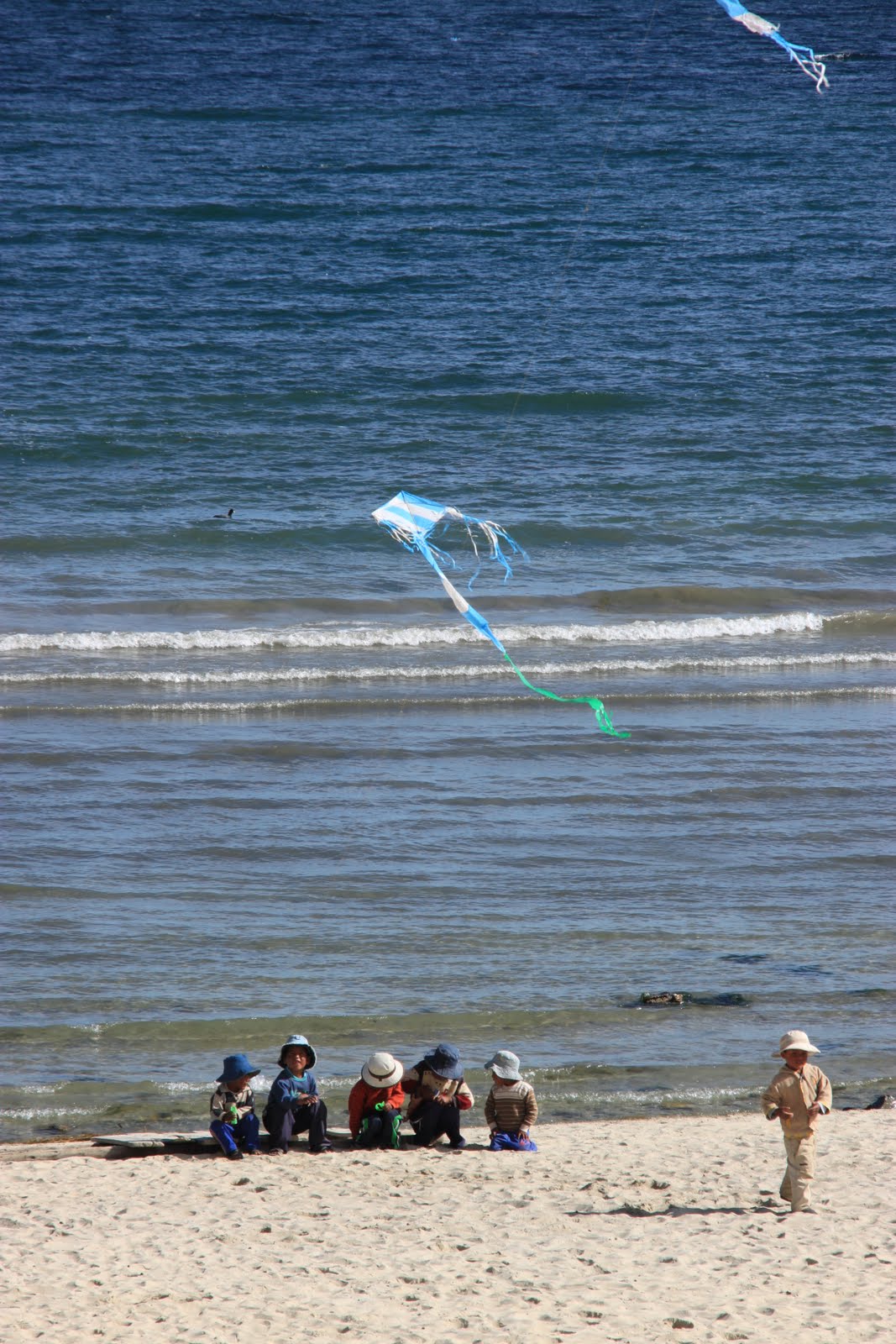
Local kids flying kites on the beach (a popular activity on the windy island)

A view from the South Tip of the Island

Marsh at a sacrificial table built by the Incans

A view of the Bolivian mountain range (Cordillera Real) across the lake

The view from our hostel's "patio" where we spent our second night

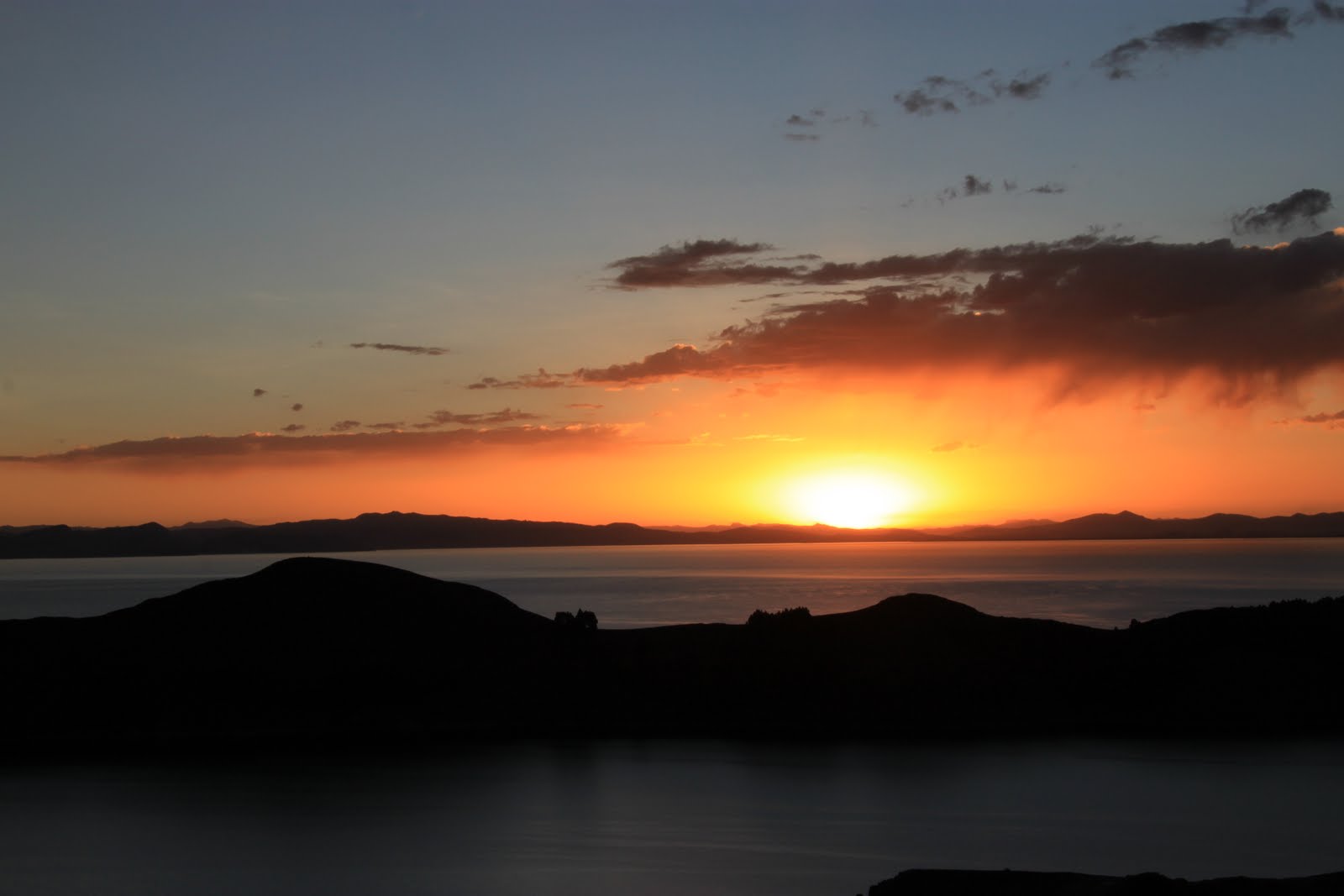
The sunset on our second night

After 2 great days we left the island and headed back to Copa, where we jumped on a bus and took the 3 hour ride to La Paz (the capital city of Bolivia). We have spent two days running some errands and checking out the city. So far Bolivia has been great. Everything is so cheap! Tomorrow, we are heading to Sorata (a small town in the Cordillera Real) to do some hiking before returning to La Paz for some mountain biking and then a trip into the Amazon Rainforest!

On another note, you may or may not know that Marsh has chosen to participate in "Movember" by growing a mustache to raise money for Prostate Cancer. To see pics of his mustache (there are 2 posted thus far) or to donate to the cause visit: http://www.movember.com/m/1855888

Hope everyone is doing well at home!
Love Marsh & Shaina

Sunday, 30 October 2011

Arequipa and Colca Canyon

Hola amigos!

We had a great couple of weeks in Arequipa and the Colca Canyon. We spent 3 days in the Colca area, hiking between towns in the canyon and seeing lots of condors! We took a bus to the small town of Cabanaconde, on the upper plateau of the Colca Canyon. In the morning we went to the Cruz del Condor lookout to watch condors ride the thermals of the giant canyon.

Cruz del Condor


The lookout and the Colca Canyon

Condors are the biggest flying birds in the world! They have a wingspan of 2 to 3 meters (9-10 ft)! and weigh 20-35 lbs. Basically a small dog with enormous wings. Condors are scavengers, feeding mainly on dead animals, like vultures. They are endangered and are very special to the Andean people. The Incas believed the condors took the spirits of the dead up to the gods, and into their next life.

A condor coasting along the edge of the canyon

A condor soaring past the tourists at the lookout

A condor flying over us - you can see it's white neck and splayed wing tips

After our exciting condor watching, we packed up and started hiking down into the 1.2km deep canyon. We stayed one night in a town near the bottom of the canyon called San Juan de Chuccho, at 'Casa de Roy'. The lady who owned it was a real sweetheart and cooked us a wonderful dinner. The cabanas we stayed in were lovely, with a stunning view of the canyon.

Day 2 we walked up through a few small towns, about midway up the canyon and then back down to the bottom to a river oasis in the town of Sangalle. Here there were swimming pools and gardens to relax in. We arrived for lunch and a bit of RnR in the hot sun and then it was a long steep climb back up the near vertical 1.2km wall of the canyon. The best part of the climb up was the condors! There were about 6 or 7 of them flying around us as we hiked. We arrived back in Cabanaconde at sunset, with a gorgeous pink light over the corn fields. What a day!

The next day we took the tourist bus back to Arequipa. We stopped a few times along the way at viewpoints, towns, and the best hot springs yet! All in all, a fantastic trip to Colca Canyon - highly recommended!

The view from the start of our hike. You can see the towns we were walking to on the other side of the canyon.

The river oasis at the bottom of the canyon

The view from the bottom of the canyon on our way to San Juan de Chuccho

Shaina relaxing at our cabanas in beautiful San Juan de Chuccho
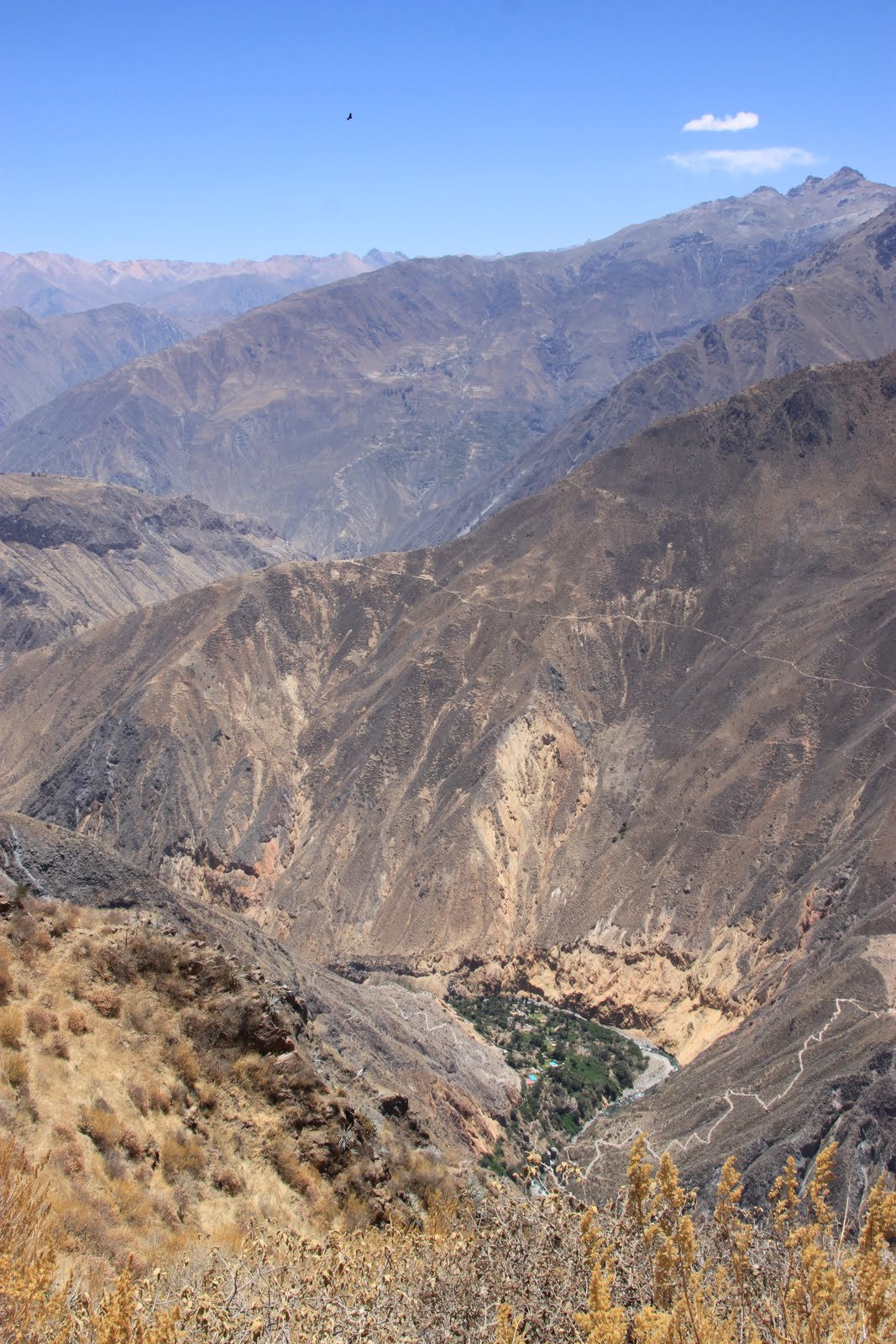
Marsh at the oasis in Sangalle

The pool in the oasis

Arriving in Cabanaconde at sunset

A view of the Colca Canyon on the drive back

Back in Arequipa, we took a cooking class at the same place we took Spanish lessons. We started with a short trip to the local market, buying a few new fruits to try and some cooking ingredients. Our menu consisted of 3 typical Peruvian dishes: (1) causa rellena - a cold appetizer dish with layers of mashed potatoes, tuna with tomato and onion, avocado, and more mashed potatoes; (2) ceviche - fish marinated in lime, chili and onion, served with sweet potatoes and corn; (3) lomo saltado - a classic dish of stir fried steak with tomato and onion served with french fries and rice. We ended the meal with the local drink of choice - the pisco sour - pisco (grape brandy), lemon juice, sugar and egg white. A delicious and fun afternoon!

In the evening, we checked out the museum with the frozen body of a girl ("Juanita") sacrificed by the Incas to the mountain gods, and saw a very interesting National Geographic documentary on it. Then we had a glass of wine overlooking the cathedral in the main plaza.

Cooking class - Shaina with ceviche (fish marinated with lime, chili and onion) and causa rellena (layers of mashed potato, tuna salad and avocado)


The cathedral at the Plaza de Armas in Arequipa

We arrived in Puno, on Lake Titicaca, yesterday afternoon. The lake straddles Peru and Bolivia and is the highest navigable lake in the world. It's also freezing cold! This week happens to be Puno Week, with festivities such as parades, concerts and fireworks going on all week. Today there was a huge parade with all kinds of different traditional costumes and music from the local indigenous groups.
Costumes during a parade for Puno Week

We're hanging out here for a couple days and visiting some islands on the lake and then crossing over into Bolivia.

Happy halloween!

love M&S
xoxo